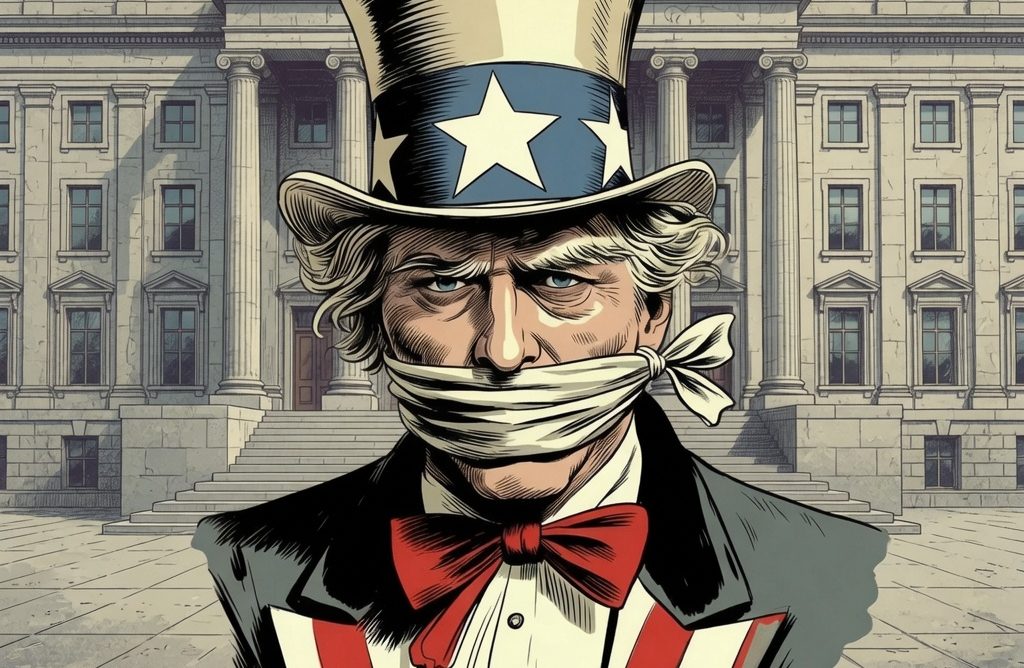
 The Trump administration has led one of the most brutal assaults on whistleblowers, journalists, and the media in modern American history. He has called the press the “enemy of the people,” blocked reporter access to public events, sued media companies, aggressively investigated journalists and used the Espionage Act to go after “leakers”. Trump’s latest information-throttling effort involves a proposed standardized federal nondisclosure agreement (NDA) – a tool with which Trump is quite familiar because he used it for years to conceal his infidelities and other unflattering information. However, NDAs for government workers are unnecessary, redundant, likely unconstitutional, and erode whistleblower protections. His new proposal is really just a repackaged attempt to silence civil servants who speak up about government malfeasance and choke the public’s right to know.
Trump’s desire to muzzle federal employees with NDAs is nothing new. He tried to do the same thing back in 2018 when the White House asked certain senior staff members to sign overbroad NDAs that went far beyond their government service to include virtually all non-public information they learned while working in the White House. Constitutional scholars, whistleblower groups, and former government ethics officials shut down those censorial antics. Yet abject rejection does not stop the unmatched stamina for failure that personifies Trump. It fuels him.
Before dissecting Trump’s regurgitated NDA proposal, it bears emphasis at the outset that government employees work for the public, not the president. It’s also worth noting that the government already has numerous NDAs. One is literally called the “Classified Information Nondisclosure Agreement”. Additionally, the government possesses a boatload of other secrecy mechanisms, including Executive Orders, the classification system, various legal privileges, and the bludgeon of strict liability secrecy laws like the Espionage Act, which has been deployed against many of the whistleblowers I represent.
Trump’s Proposed Hush Agreement
Trump’s expansive NDA would apply to “non-public, confidential, or proprietary information, whether or not marked as such, which may include […] information relating to internal agency operations, personnel matters, personally identifiable information (PII), personal health information (PHI), procurements processes, or any sensitive, pre-decisional or deliberative material that is not currently publicly available…” (emphasis added). At first blush, this may not sound objectionable because of the dry bureaucratic buzz words and abbreviations. But upon closer examination, cracks emerge.
First, the overwhelming majority of government information is “non-public.” As NSA whistleblowers I represent have explained, the government is drowning in data. The federal government’s own public data portal, Data.gov, contains hundreds of thousands of datasets, which is an infinitesimally small sliver of the emails, files, paperwork, records, contracts, and other information generated across the government. Non-public government information also includes an ocean of minutiae – from the cafeteria lunch menus to memos on preferred computer fonts to instructions for disposing of broken office furniture. Employees would have to worry about communicating about, basically, any and all of it.
Next, the “whether or not marked as such” language is truly frightening. Every single criminal leak case has centered on the alleged mishandling of classified information. How it is marked (or not) is critical. One of the most egregious prosecutions of a whistleblower – that of former NSA senior executive Thomas Drake – epically collapsed because the information he was accused of mishandling turned out not to have been classified. The government tried to make a “classified by inference” argument that, even though the information at issue was specifically marked unclassified, Drake should have known that it should have been classified. The court emphatically rejected the modal “should.” But the Trump administration now thinks employees should face fines and even criminal penalties for discussing even benign information.
That brings us to redundancy. During the past few years, there have been an increasing number of national security and non-national security gag orders, many of which are overbroad and vague. When the adjective “classifiable” was removed from executive branch gag orders, new hybrid secrecy categories bloomed in abundance, including “Sensitive But Unclassified,” “Sensitive Security Information,” and “Critical Infrastructure Information.” There are some 164 designations or subcategories for controlled unclassified information. These pseudo-classification categories all do the same thing: create employment risk and criminal liability for non-classified disclosures of pretty much anything without prior permission. It’s a form of prior restraint secrecy.
PII is already protected by the Privacy Act of 1974 and hundreds, and likely thousands, of agency documents address it. PHI is also protected by a law, the Health Insurance Portability and Accountability Act (HIPAA) and related regulations. Anyone who has ever tried to get their own medical records has heard of HIPAA. As for procurement processes, those encyclopaedic rules are contained in the prolix Federal Acquisition Regulation (FAR), which spans 2,000 to 4,000 pages depending on the print format. Finally, internal discussions, recommendations, and draft documents are already protected from public disclosure by the deliberative process privilege, a legal doctrine that allows government agencies to withhold them.
Killing “Anti-Gag” Precedent and Expanding Secrecy
OPM director Scott Kupar didn’t try to hide the fact that the Trump administration’s proposed NDA aims to “help agencies better protect against unauthorized disclosures,” which is code for press leaks. Federal workers don’t check their workplace free speech rights at the door. Since 1998, Congress has included an anti-gag statute in annual appropriations laws to prevent agencies from using NDAs that could restrict whistleblowing or communications with Congress. It draws a line in the sand on Executive branch efforts to limit whistleblowing to classified information.
And the Whistleblower Protection Enhancement Act of 2012’s “anti-gag” provision is clear on this point. It is a prohibited personnel practice for agencies to implement or enforce NDAs that do not contain specific language preserving whistleblower rights. Federal NDAs must acknowledge that they don’t override an employee’s ability to communicate with Congress, report wrongdoing to an IG or the U.S. Office of Special Counsel, and don’t supersede, conflict with, or otherwise alter rights created by whistleblower statutes and related laws – at least when it comes to unclassified information.
It is bad enough that Trump has dismantled much of the accountability apparatus of the federal government – mass firings of Inspectors General, dismantling oversight agencies and offices, firing those who investigated him, revoking security clearances without cause, and retaliating against whistleblowers and perceived political enemies. Gag orders are more insidious and destructive than classic whistleblower retaliation (demotions, poor performance reviews, reduction in pay, etc.) because they prevent information from getting out in the first place. That’s why so many government offices have anti-gag policies.
Trump knows that gag orders have a chilling effect and that clamping down on the free flow of information breeds an unhealthy work environment. It does not matter to him. The contractual silencing and steep penalties is precisely the point. His second bite at the NDA apple begs the more germane question of what, exactly, Trump is trying to hide that is so big and so vast that he feels he needs to silence the entire federal workforce.
Jesselyn Radack represents Edward Snowden and a dozen other individuals investigated or charged under the Espionage Act. She heads the Whistleblower & Source Protection Program (WHISPeR) at ExposeFacts. As national security and human rights director of WHISPeR, her work focuses on the issues of secrecy, surveillance, torture and drones.